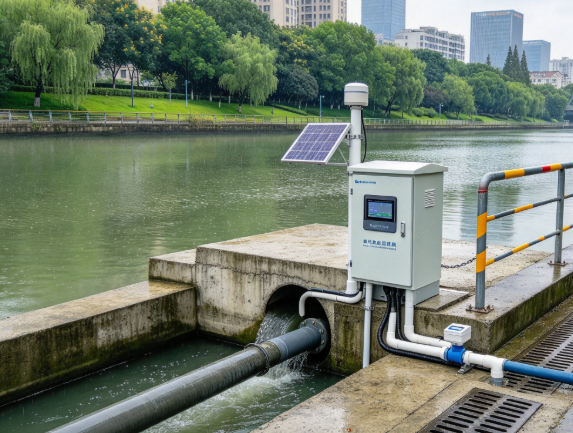
A circulating water monitoring system is a core tool for chemical and coal-chemical plants to eliminate hidden energy waste caused by small, unseen leaks in cooling water loops. Minor leaks in circulating water pipelines and heat exchangers often appear trivial at first glance, but they accumulate into significant water loss, material contamination, and extra power consumption over time. Even a single 3 mm leak can discharge hundreds of tons of process water per year. More critically, leaks allow process chemicals and raw materials to seep into the circulating water, causing sudden spikes in COD, turbidity, and conductivity.
Once water quality falls outside the controlled range, a cascading chain of operational problems follows. Scale and electrochemical corrosion accelerate across heat exchanger surfaces and pipe walls. Heat transfer efficiency drops sharply as mineral deposits build up. To compensate for lost cooling capacity, circulating pumps must run at higher frequency and load, leading to an exponential rise in energy use. Traditional manual inspection and offline lab sampling can barely detect minor internal leaks at an early stage. Most abnormalities are only identified after obvious performance degradation, when economic losses have already taken place.
How a Circulating Water Monitoring System Detects Leaks Early
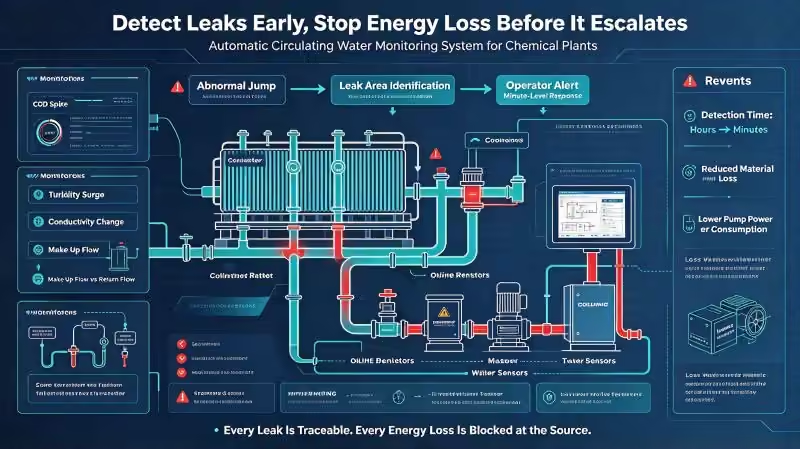
Shandong Dongrun Instrument’s automatic circulating water monitoring system for chemical plants delivers continuous online tracking of key water quality parameters, including COD, turbidity, conductivity, ammonia nitrogen, and the flow difference between make-up water and return water. This real-time data capture enables the system to identify leak events immediately and trigger early warnings before damage spreads.
When parameters show abnormal jumps within a short time window, the built-in intelligent algorithm automatically locates suspected leak sections and heat exchanger positions. Alert notifications are pushed to on-site operators for prompt investigation and maintenance. Compared with traditional manual inspection, which can take hours or even days to locate a fault, this solution reduces leak detection time from hours to minutes. This greatly cuts chemical material loss, protects circulating water stability, and avoids accelerated equipment damage caused by contaminated cooling water.
Chemical Plant Water Leak Detection and Energy Impact
For chemical facilities, the cost of a leak goes far beyond direct water waste. When process fluids mix into circulating water, the entire cooling loop suffers from accelerated scaling and corrosion. Over time, this reduces heat exchanger efficiency and forces pumps to consume more electricity to maintain target temperatures.
Relying only on regular patrols and manual sampling means chemical plant water leak detection always lags behind actual fault occurrence. By the time operators notice abnormal water quality or declining cooling performance, extra energy consumption and equipment wear have already become irreversible losses.
Heat Exchanger Leak Energy Loss: A Hidden Cost
A domestic coal-chemical enterprise deployed Dongrun’s circulating water monitoring solution across its production cooling circuits. During one year of operation, the system successfully issued advance warnings for three separate micro-leak incidents in heat exchangers. Timely maintenance prevented heat transfer efficiency decline and large-scale pipeline corrosion.
Internal enterprise data shows that if each leak had gone undetected for an extra 24 hours, circulating pump energy consumption would have increased by 8%–12%. Combined with lost raw materials, extra water treatment chemical dosing, and higher wastewater disposal costs, total loss per incident could have exceeded 100,000 RMB. Through leak warning alone, the system helped the plant recover nearly 300,000 RMB in avoided losses within its first year. This case clearly demonstrates how heat exchanger leak energy loss forms an invisible cost center for process plants.
Online COD Turbidity Monitoring: Dual Detection Mechanism
Beyond water quality-based leak diagnosis, the system continuously compares make-up water flow and return water flow in real time. Flow deviation analysis accurately identifies pure water pipeline leaks that cannot be detected by water quality sensors alone. This dual-detection mechanism covers both cross-contamination leaks and invisible water loss failures.
Online COD turbidity monitoring captures process fluid ingress events, while flow difference analysis catches pure water leakage. The two complementary mechanisms ensure no leak type slips through the monitoring network, maximizing energy and water savings.
Industrial Water Quality Monitoring for Long-Term Efficiency
For chemical and coal-chemical enterprises, circulating water systems are critical infrastructure supporting continuous production. Unnoticed leaks create an invisible energy black hole that wastes water, electricity and raw materials day after day.
Systematic industrial water quality monitoring does not only respond to existing faults — it builds a long-term optimization mechanism for plant operation. By continuously tracking water quality trends, equipment health, and energy consumption patterns, plants can gradually optimize circulating pump operation schedules, reduce unnecessary power draw, and extend equipment service life.
Shandong Dongrun Instrument’s automatic circulating water monitoring system makes every potential leak point traceable, blocking energy and material loss at the source instead of addressing damage after it occurs. Investing in this online monitoring platform not only saves water resources, but also helps chemical plants cut hidden energy waste, reduce equipment maintenance costs, and achieve safer, more energy-efficient operation.