To ensure production safety, many chemical plants habitually control the circulating water supply temperature at an “absolutely safe” low level—for example, keeping it below 28℃ all year round. However, this “over-cooling” comes at a high energy cost: for every 1℃ drop in supply temperature, the power consumption of cooling tower fans and circulating pumps increases by approximately 4%–6%, while many heat exchangers in actual operation do not require such low cooling water.
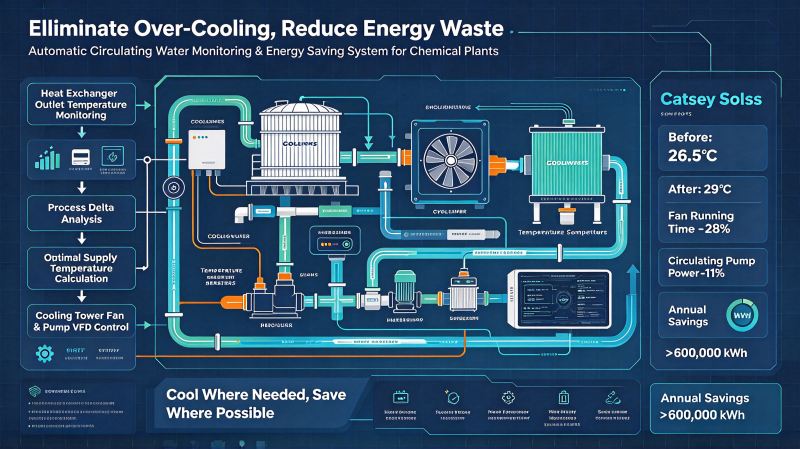
Shandong Dongrun Instrument’s automatic circulating water monitoring system for chemical plants accurately identifies over-cooling areas by real-time monitoring of the outlet temperature of each heat exchanger and the process required temperature difference. The built-in energy efficiency optimization algorithm automatically calculates the optimal supply temperature setpoint based on the current ambient wet-bulb temperature, production load, and the actual cooling demand of each heat exchanger, and then dynamically adjusts the cooling tower fans and circulating pump inverters.
Before applying Dongrun Instrument’s system, a new materials enterprise had an average circulating water supply temperature of 26.5℃. After commissioning, while ensuring that all heat exchanger outlet temperatures met requirements, the system automatically raised the supply temperature to 29℃. Although the increase was only 2.5℃, the comprehensive results showed that the daily operating time of cooling tower fans was reduced by 28%, circulating pump power consumption decreased by 11%, annual electricity savings exceeded 600,000 kWh, and the estimated annual cost saving was about 480,000 RMB.
More importantly, the system continuously monitors changes in the heat load of each heat exchanger. When some production lines operate at low load, the system automatically raises the supply temperature of the corresponding branch, avoiding a “one-size-fits-all” low-temperature supply. This refined temperature management also reduces the loss of condensed water vapor recovery caused by over-cooling.
This automatic circulating water monitoring system enables chemical plants to “cool where cooling is needed, and avoid waste where cooling is not needed.” Eliminating over-cooling means eliminating energy consumption blind spots.